
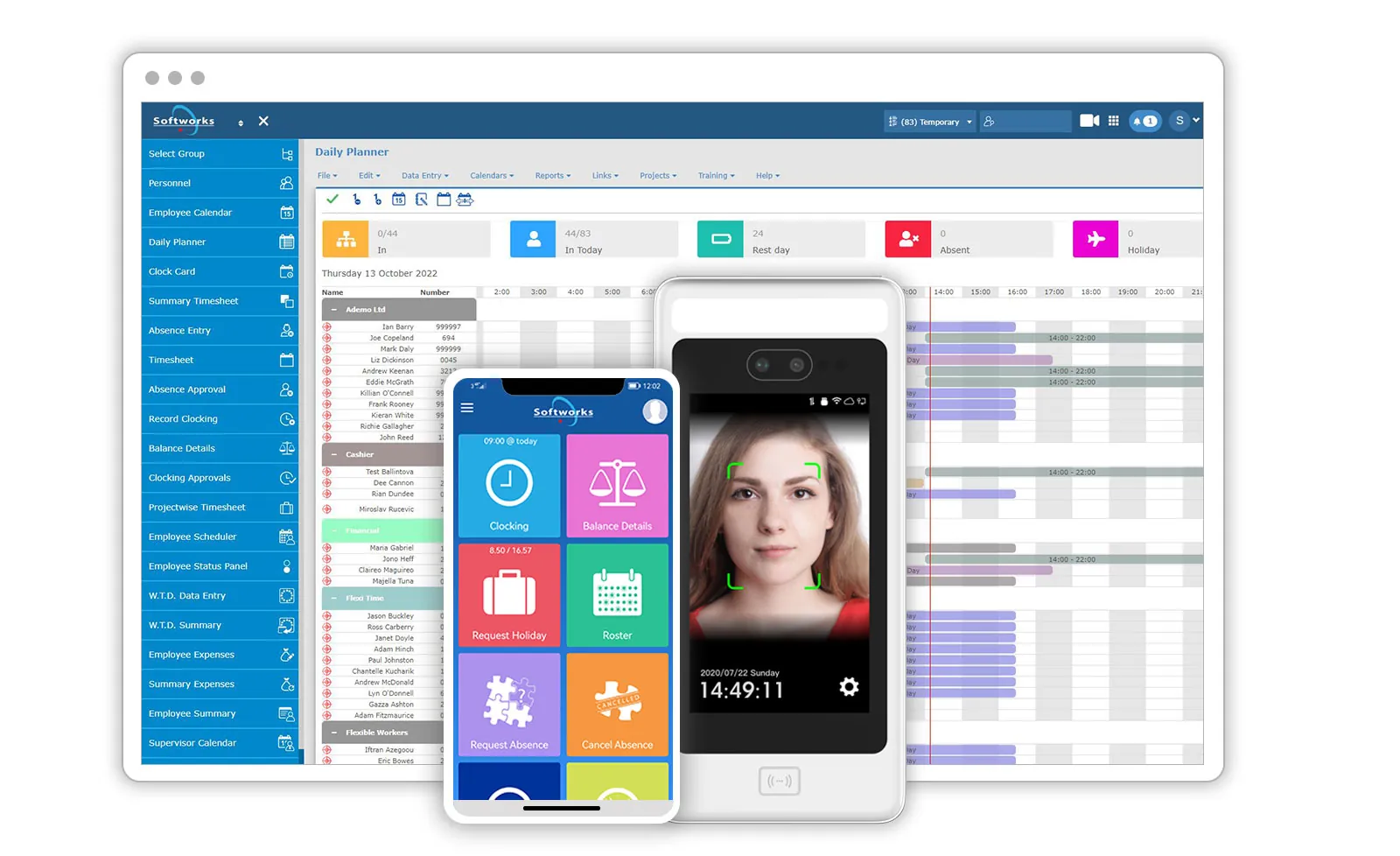
Softworks All-In-One Workforce Management Software integrates the Acuity-Based Staffing model to provide an optimised solution to Healthcare Employee Scheduling, Time and Attendance, Absence Management and much more.
Acuity Based Staffing Tool

- · Align staff rosters with Patients’ Acuity
- · Track patient dependency levels per ward
- · Identify wards that require revised staffing levels
- · Generate staff-to-patient assignments
- · Automate workforce administration
- · Ensure regulatory compliance







Patient Acuity is the measurement of the intensity of nursing care required by a patient. Healthcare organisations use patient acuity assessment to optimise their nursing resources and provide high-quality care to their patients.
What is the Acuity-Based Staffing model?
Acuity-based staffing allocates resources based on patients’ needs, rather than just patient numbers. Assigning the number of nurses needed per shift based merely on the number of patients may not be in the best interests of patients. For example, patients may require a dedicated nurse 24/7 when in intensive care but need minimal care on the day they are discharged.
With our automated acuity-based staffing solutions, you can optimise nursing rosters and assignments with patients’ dependency needs and be sure that you are making the best use of your workforce. It allows you to achieve quality patient outcomes, more efficient employee scheduling, reduced costs and increased employee satisfaction and retention.
Benefits of Workforce Management Software based on Patient Acuity
- ALIGN staff rosters with patients’ acuity. Schedule shifts by considering skills, experience and patients’ acuity levels.
- TRACK patient dependency levels across wards by integrating with tools like Shelford Acuity Tool, NICE, RAFAELA, and NHPPD.
- ASSESS the level of care required by each patient and schedule staff accordingly.
- MATCH required nursing FTE vs actual rostered FTE hours.
- IDENTIFY the number of staff required in each ward on a daily basis.
- ASSIST ward managers in identifying wards requiring revised staffing levels.
- MONITOR patient dependency levels and generate staff-to-patient assignments based on these levels.
Areas We Help
Available Clocking Systems
Related Content


Leading hospitals use Softworks Solutions
The Mater Private are delighted with their new system….

Request a free Demo!
Take the first step towards a complete workforce management solution. Talk to us today!
What is Acuity-Based Staffing?Acuity-Based Staffing by Softworks determines patient acuity—the degree of care needed—by means of a Patient Classification System (PCS) and Clinical Complexity Scoring in order to assign nursing resources according to the real dependency of patients rather than on the number of staff members.
The platform transforms healthcare operations across four key areas:
- In terms of patient care and patient satisfaction, nursing care needs are tracked by balancing the time given to direct care with the time spent on indirect care through the use of customisable acuity metrics in order to ensure that patients with high care needs receive dedicated care, thus improving clinical outcomes, patient safety indicators, and overall patient satisfaction.
- Savings on costs and control of wage expenses: by using real-time patient data the need for guessing in rostering is eliminated, overtime costs—which are expensive—are considerably reduced as a result of Overtime Reduction, thus aiding Wage Cost Control and improving Budget Forecasting.
- Nurse satisfaction and staff morale will increase by fairly distributing workloads according to the nurses’ capacity, availability, skills, and the Minimum Staffing Requirements; this acts as an effective nurse retention strategy and helps to improve staff morale while preventing burnout.
- The system provides a visual indication of staffing variations in real time so that staff can effectively manage fluctuations in demand and hospital flow, enabling managers to quickly reassign nurses to the units that are experiencing unexpected increases in care.
By linking staffing directly to patient dependency, Softworks enables healthcare facilities to achieve greater budget efficiency, improve patient safety, and keep their workforce agile.
The company is dedicated to transforming Healthcare Workforce Management, on the ground that the quality of patient care is dependent on the well-being of staff and on the effective deployment of fully-qualified personnel. Softworks is always working to enable organisations such as yours by turning complicated operational problems into clear strategic benefits. Since the healthcare environment is complex and frequently unpredictable, conventional staffing methods are often unable to meet the needs of modern medical facilities.
Softworks’ Acuity-Based Staffing Tool
The Acuity-Based Staffing tool forms part of a full-scale Workforce Management (WFM) platform which is intended to meet the particular challenges experienced by hospitals, nursing homes, and care providers; it provides support for Unit/Ward Staffing and Clinical Workload Management so that you can give the right care at the right time while at the same time maximising efficiency and staff satisfaction.
Deliver Substantial Workplace Benefits Automatically
Softworks provides automation for the complex work rules and pay policies that are already in place within your organisation. This automation gets rid of the time-consuming manual tasks associated with employee Time and Attendance Data, Absence, Flexitime, Skills & Training management, and so on. The automations give the healthcare industry the strategic benefit it needs in order to cope with the present situation involving staff shortages, financial pressures, and the continuously growing demand for high-quality care. Our WFM solutions simplify HR processes, boost productivity, promote Labour Optimisation, and keep Safe Staffing Levels intact by improving management, Staff Scheduling, and the way resources are deployed. This all-round approach is necessary if optimal operational efficiency and a genuinely engaged workforce are to be achieved.
Acuity-Based Staffing Tool: For a Smarter Workforce
The fundamental principle of delivering effective healthcare is to have the appropriate number of qualified staff where they are needed most at the right time. In the current demanding environment of healthcare, traditional methods of staffing usually do not meet expectations since they tend to rely merely on the number of patients, on fixed Nurse-to-Patient Ratio goals, or on strict Staff-to-Patient Ratios. Such approaches do not take into account the important variations in patient needs and as a result cause poor quality of care, overwork among the staff, and considerable financial inefficiencies. At Softworks we advocate a more intelligent strategy, one that is completely reflected in our Acuity-Based Staffing Tool.
The Core Concept of Acuity
The Nurse Staffing used by Acuity-Based Staffing considers the amount of care needed by each individual patient or resident. Instead of allocating resources simply according to the number of patients, our system determines Nurse Staffing on the patients’ real needs—that is, on their degree of dependency, the intensity and complexity of their care, and on the particular tasks that have to be carried out. This makes it possible for patients with high levels of dependency to get sufficient resources, which in turn leads to better patient outcomes and improved safety. This is done by systematically applying Patient Acuity Measurement tools. In the case of long-term care settings, this means carrying out an accurate Resident Acuity Assessment.
Accommodating Patients’ Individual Healthcare Needs
Healthcare providers can make sure that the care they give is suitable to the individual patients’ dependency needs by adopting an acuity-based method, which in turn results in better quality and safer care. This is especially important when addressing the variety of patient groups and the growing demand for specialised care in an ageing society. With our system you are able to monitor dependency levels in each unit by using accredited tools or Customisable Acuity Metrics, gaining detailed insights into where resources are most required.
Benefits of the “Smarter” Approach
The move to Acuity-Based Staffing represents a change from a reactive to a proactive approach to workforce planning, achieved by using Care Demand Forecasting and Predictive Staffing Models. Rather than having to rush to fill staffing gaps or cope with the consequences of understaffing, our tool enables managers to anticipate staffing needs and make well-informed decisions. This more intelligent method leads to considerable cost savings by producing schedules that are more accurately tailored to real patient data. Since the software lessens the need for expensive overtime and temporary staff from agencies, it results in substantial savings which can then be reinvested either in improving care services or in supporting your staff. This is an example of true Labour Optimisation.
Fostering a More Positive Workplace
The effects of poor scheduling—such as workers becoming overworked, stressed, and dissatisfied, which in turn leads to burnout, absenteeism, and high turnover rates—are well known. According to a survey carried out by ConnectRN, 50% of nurses said they were considering leaving their profession and 32% felt that they were not supported, thus showing the urgent need for measures which improve staff well-being. Our system deals with this issue by introducing Fatigue Management Protocols and by matching the amount of work to the capacity and availability of each nurse, thus avoiding overload and making sure that the work is distributed fairly. This in turn results in a more happy, fair, and positive working environment, something which is essential for a long-term Nurse Retention Strategy.
Digitalization and Integration
The Softworks Workforce Management system automates those tasks which have usually been carried out manually, including the processing of holiday requests and paid time off (PTO), the approval of timesheets, the updating of Care Plans, and the tracking of skills. By bringing all these functions under Centralised Data Management we are able to save time for everyone, improve the accuracy of the information, and greatly enhance employee engagement. Our systems record complete up-to-the-minute information, provide insightful dashboards, and include historical data reporting together with full Audit Trails, Digital Documentation, and compliance with GDPR.

Improve Patient Outcomes and Drive Savings
The process of digitalising healthcare workforce management brings about a revolution in everyday operations, improves patient outcomes and results in cost reductions. Because our Acuity-Based Staffing Tool integrates smoothly with other Workforce Management modules, such as those relating to HR and payroll, it offers a genuinely comprehensive solution. This method of centralisation increases accuracy, lessens the administrative workload, and guarantees that the data complies with regulations such as GDPR.
Key Features of Our Acuity-Based Staffing Tool
The Acuity-Based Staffing Tool has a number of strong features which meet the special demands of healthcare scheduling, whether it be dynamic patient requirements, a variety of staff skills or strict regulatory requirements. It provides a fully automated workforce management system which enables you to handle complicated scheduling and roasting, improve efficiency, reduce costs, lower absenteeism and ensure Regulatory Compliance (for example, with regard to CQC), all while at the same time giving excellent patient care.
1. Assessment of core acuity and the creation of an optimised schedule
Acuity Assessment
At the heart of our solution, the system identifies the amount of nursing or care required for each patient or resident based on:
- Individual dependencies
- Intensity of symptoms
- Complexity of conditions
- Condition-specific tasks
It is known as the Patient Acuity Measurement or the Resident Acuity Assessment.
Optimised Rostering
Our Staff Scheduling and eRostering solutions are able to produce schedules that match your workforce with the demand which is focused on the patient. The system considers the necessary mix of skills and employee preferences and thus creates optimal schedules with just a simple action. This makes it so that the right person, possessing the appropriate skills, is in the right place at the right time—using Rostering Software Integration when it is necessary to communicate with external systems.
Safe Staffing Levels & Skill-Mix Optimisation
By using acuity data the system is able to work out the number of Care Hours Per Patient Day (CHPPD), which enables managers to establish and keep an eye on Safe Staffing Levels. The system also promotes Skill-Mix Optimisation by making sure that the correct ratio of registered nurses (RNs), licensed practical nurses (LPNs) and certified nursing assistants (CNAs) is in duty.
2. The management of comprehensive skills and training
- For tracking certifications: The Learning & Skills Tracking feature enables you to monitor your employees’ skills, training, qualifications, and most important of all, the expiry dates thereof through effectiveCertification Tracking.
- In the case of qualified deployment, only personnel who are properly qualified and who satisfy the requirements for mandatory training are assigned to each task, thus improving both patient safety and the quality of care.
- Automated alerts for certifications that are about to expire help protect your organisation from regulatory risks by enabling proactive retraining.
3. Giving employees self-service (ESS) and access via mobile device
- Greater Control: The Employee Self-Service (ESS) app that is available on smartphones, tablets, and desktops gives healthcare professionals more control over their own working lives.
- Flexibility and Transparency: Employees are able to record their arrival and departure times (with GPS tracking), see their schedules at any time of the day or night, request time off, and carry out shift swaps. The degree of transparency and the amount of autonomy available increase job satisfaction and reduce staff turnover.
4. The ability to have real-time visibility and making decisions based on data
- Instant Insights: The comprehensive Reports and Dashboards offer Workforce Analytics, Productivity Reporting, and clear visibility regarding attendance trends, overtime, costs, absence patterns, Resource Utilisation, and leave balances.
- By taking a proactive approach, insights from real-time demand forecasting enable your managers to respond to changes in patient demand or to unexpected staff shortages, thus promoting true data-driven decision making.
5. Using AI-driven insights for proactive management of absences
- Our Absence Management Software includes a centralised system which allows absences to be tracked according to their type, how often they occur, and the patterns they follow.
- To minimise disruption, automated workflows and alerts inform managers of unexplained absences or lead to return-to-work interviews, enabling proactive intervention and thus reducing disruption.
- When schedules have been created, AI-powered forecasting analyzes historical patterns of change and trends of absences in order to predict the likely number of people who will not show up.
- Make sure to adjust the schedules proactively, reallocate the staff, and have adequate backup arrangements in place so that any disruptions are minimised before they affect patient care. This approach deals with Risk Management (which relates to understaffing).
6. Seamless Regulatory Compliance
- Automated Tracking: Since the healthcare industry is subject to strict regulations concerning working hours, rest periods, and patient safety, our WFM software automatically monitors compliance with these regulations, thereby ensuring adherence to regulatory standards (such as those set by the CQC) and reducing the likelihood of incurring substantial fines.
- PBJ Reporting: For US nursing homes, ourFairness: Our system includes adjustable fairness rules so that shifts are distributed fairly. The correct calculation of Care Hours Per Patient Day (CHPPD) acts as a key Quality of Care Indicator.n of Care Hours Per Patient DayThe Vacancy Alerter will send email and text alerts to available and eligible staff so that they can immediately apply for open shifts.o available and qualified staff, allowing them to instantly apply for open shifts.
- Reducing dependence on agency staff: This forward-thinking method guarantees smooth operations, reduces staff variations, and at the same time minimises reliance on expensive agency personnel.
From Patient Acuity to Optimal Staffing
For any healthcare organisation, moving from traditional and frequently inefficient methods of staffing to a genuinely optimised, acuity-based approach is a fundamental change. At Softworks we don’t merely offer software; instead we establish a strategic partnership that facilitates this transition and has a clear positive effect on patient outcomes, on the well-being of staff, and on your operational bottom line.

Strategic Impact and Risk Management
By adopting an acuity-based method, you can make sure that the care provided is always in line with each patient’s level of dependency, thus improving both the quality and safety of that care. This advanced approach also results in substantial cost savings.
- Lowering agency costs: Our software leads to a reduction in overtime by setting up more accurate schedules based on real patient data and therefore reduces the need for temporary staff from agencies. The amount of money saved is considerable and can be directly reinvested in care services.
- The system allows for the monitoring of Quality of Care Indicators and Patient Safety Metrics by linking staffing levels to acuity needs, and the calculation of Care Hours Per Patient Day (CHPPD) is a key figure for showing that resources are being used appropriately and that quality standards are being met.
- Risk mitigation involves setting up and keeping an eye on safe staffing levels in accordance with patient needs, as this is a key aspect of risk management (particularly in the case of understaffing). The system reduces the risks linked to poor care and non-compliance by achieving skill-mix optimisation.
Staff Well-being and Retention
The software helps create a more positive working environment and boosts staff morale as a way of strengthening your nurse retention strategy.
- Equitable Workload: By matching work to a nurse’s skills, experience, capacity, and availability, our system prevents overload, distributes work equitably, and reduces stress. This proactive approach directly combats burnout and supports retention efforts.
- Empowerment: Our Employee Self-Service (ESS) app empowers staff with options to view schedules, request leave, check allowances, and perform Shift Swapping, enhancing work-life balance and job satisfaction.
Agility and Integration
Our software offers real-time adjustments and flexibility, essential in dynamic healthcare environments.
- Dynamic Staffing: Managers can identify staffing levels across departments for instant visualization of Staffing Variances, making necessary adjustments on the fly. Dynamic adjustment is key to Real-time Demand Forecasting.
- Seamless Integration: The seamless integration of our Acuity-Based Staffing Tool with Rostering Software Integration, Bed Management System Integration, and EHR (Electronic Health Record) Integration or Electronic Health Record (EHR) connectivity provides a truly holistic solution. This Centralised Data Management enhances accuracy, reduces administrative burdens, and ensures compliance with regulations like GDPR. Furthermore, leadership can leverage Workforce Analytics to conduct Benchmarking (Internal/External) and What-If Scenario Planning.
Trust Softworks to Transform Your Business’s Scheduling
Softworks has over three decades of experience assisting organisations worldwide in structuring their working day to become more productive and profitable. Our solutions are trusted by hospitals and healthcare providers globally, tackling challenging problems like complex rostering, regulatory compliance, and employee engagement. We offer comprehensive project management, consulting, training, and support to ensure your long-term success.
Ready to elevate your patient care, optimise your workforce, and empower your dedicated healthcare professionals? Book a Demo today and let Softworks show you the transformative potential.


